
Key takeaway
Google’s May I/O update shows that the Search we all know (and mostly tolerate) is moving towards longer, more detailed, AI-led searches.
For law firms - your content needs to answer the kinds of questions clients actually ask before they instruct you.
What are the recent changes announced by Google?
Google’s I/O 2026 update gives a very clear indication of where Search is heading.
Google is pushing AI Mode further into the core search experience, upgrading it with Gemini 3.5 Flash, redesigning the Search box, adding easier follow-up questions from AI Overviews, and introducing Search agents that can monitor information and complete tasks on behalf of users.
For law firms, this is important.
Obviously, not every prospective client is going to start using AI Mode tomorrow. But Google is showing us the direction of travel.
Search is becoming less static, less keyword-led and much more dynamic.
So what are the changes?
What does Google’s redesigned Search box mean for law firm SEO?
One of the most interesting parts of the announcement is Google’s redesigned Search box.
Google says the new Search box will expand dynamically, help users formulate better questions, and allow people to search using text, images, files, videos and Chrome tabs.
These changes are a big shift.
Law firm SEO has typically been built around the way people type short searches into Google:
employment solicitor London
divorce lawyer near me
settlement agreement advice
shareholder dispute solicitor
Those types of searches are not clearly going away for a while.
But Google is clearly encouraging people to give Search more context.
The reason that matters is because most prospective clients do not start their search with the right legal terminology. They start their journey with a situation.
They might not search for “unfair prejudice petition”. They might search:
“My business partner has stopped giving me access to the company accounts and is making decisions without me.”
They might not search for “financial remedy proceedings”. They might search:
“My wife and I own a business and we are getting divorced. What happens to the company?”
The law firms that benefit will be the ones whose content connects legal terminology with the way clients actually describe their problems.
How will follow-up questions in AI Mode change the legal search journey?
You might be familiar with the AI Overview section now at the top of the normal search results (and the often ridiculous answers it can provide).
Google is now making it easier for users to move from an AI Overview directly into AI Mode and continue the conversation with follow-up questions. Google says the user’s context stays with them, and the links and supporting articles become more relevant as the search develops.
That is important for law firms.
A client journey may no longer be one search, one results page and one click.
It may look more like this:
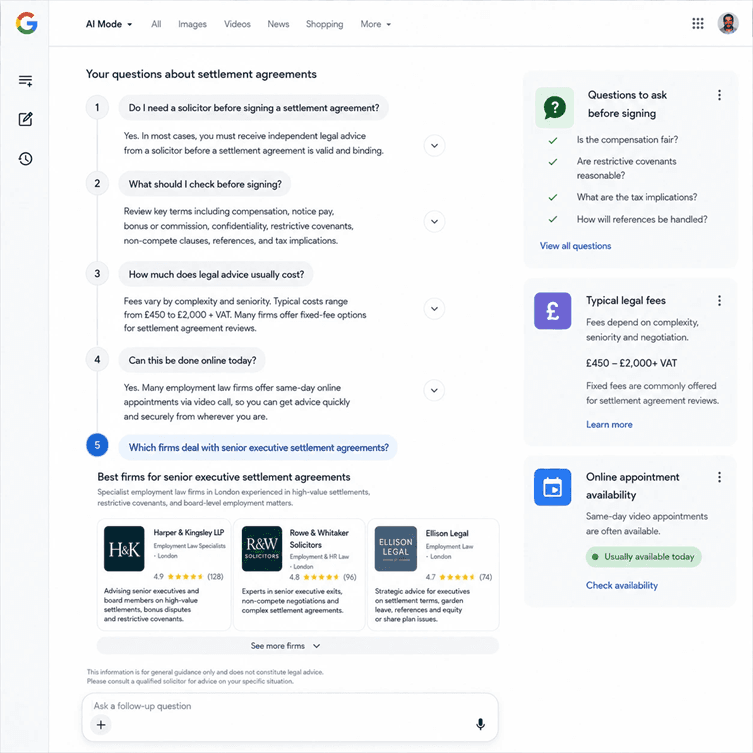
This is a very different type of search behaviour.
It’s an area which is changing quickly, and our view is that law firms should be generating content which covers different stages of the journey properly. A single standard service page is unlikely to be enough.
The stronger approach is to build a cluster of useful content around the questions clients ask before they enquire, then connect that content clearly to the relevant service page and lawyer profiles.
If someone asks about being excluded from company decisions, Google needs to understand whether your firm actually advises on shareholder disputes, director disputes, unfair prejudice claims and urgent injunctions.
If someone asks what happens to a business during divorce, Google needs to understand whether your family team deals with business assets, valuations, complex financial remedy work and owner-managed companies.
Your website needs to give Google enough substance to understand where your firm is relevant.
What do Search agents mean for law firms?
Google also announced Search agents.
These are AI agents inside Search that can monitor information, reason across sources and send updates when something changes. Google says these will start with information agents for Google AI Pro and Ultra subscribers this summer.
For now, Google’s examples are consumer-focused.
But the direction is relevant to law firms.
If Search can monitor the web for a user’s specific requirements, then discovery becomes less dependent on a single search at a single moment.
A prospective client could ask Google to keep track of firms, guidance, pricing, reviews, legal updates or local providers that match a particular need.
To us, this suggests that Search is moving towards a more active role in the decision process.
It’s another argument for strengthening your law firm’s authority signals across the internet i.e. securing higher quality backlinks, being mentioned in the right reputable places, getting ranked in the legal directories.
What should law firms do after Google’s AI mode update?
The firms that will be better placed for AI Mode are the ones that make their expertise easy to understand.
That means:
stronger service pages
clearer lawyer profiles
useful insights built around real client questions
better internal linking
consistent local SEO
credible third-party signals
clear calls to action
For more, we wrote a recent guide on how law firms can improve their rankings in AI searches.
This is also where legal directory content can be useful beyond submissions. Directory work often forces firms to define their best matters, strongest lawyers and clearest points of difference. That same information can support website content, lawyer profiles and AI search visibility.
We have written more about this in our recent article on repurposing legal directory submissions for maximum ROI.
Final thoughts
The I/O update shows that Google Search is becoming more conversational and more dynamic.
AI Mode is changing the way law firms acquire clients, and changes the job of SEO in general. Firms need to be understood across a wider range of client situations.
That means writing content that reflects how clients actually search, structuring practice areas clearly, strengthening lawyer profiles and making authority signals easier for Google to recognise.
The firms that do this well will ultimately win in this new environment.
If you want to understand how to improve your law firm’s AI search visibility, contact us today and let’s discuss how we can take your marketing to the next level.
About author
Mo leads our marketing strategy, with a focus on SEO, communications and lead generation bringing 9 years of B2B marketing experience. When he is not advising law firms on their marketing, he is (often painfully) supporting his beloved Fulham FC.

Mo Elmoussati
Director
Get actionable insights tailored to ambitious firms
Marketing Insights, resources and the occasional piece of witty coffee sipping content, neatly packaged into our monthly mailing (zero spam, zero zzz's)!