Case Study
How we helped a legal support services business grow their organic enquiries by 300%
Service
Legal Marketing
Service
Legal Marketing
Topics
SEO · PPC Advertising · Content Marketing · Web Design · Email Marketing
Topics
SEO · PPC Advertising · Content Marketing · Web Design · Email Marketing
Practices
Legal Support Services
Practices
Legal Support Services
Year
2024
Year
2024

We were instructed by a legal support services business to take over their organic marketing. This client did not have any in-house marketing resources, and had previously worked with a generalist marketing agency who did not have experience in the legal sector.
The challenges
Our client is a specialist expert witness provider serving the criminal law sector, supports solicitors, barristers, and legal aid organisations with expert testimony across forensic science, digital evidence, and psychological evaluation.
The client was struggling with:
A broken website infrastructure that limited search visibility.
Declining keyword rankings for competitive “expert witness” terms.
Fragmented organic marketing activity with no unified strategy.
The firm relied on word-of-mouth referrals but recognised the need to build a sustainable inbound lead engine.
Our organic marketing strategy
We created a unified organic marketing strategy split into 5 key steps:
Rebuilding the website for technical performance and scalability.
Improving visibility for high-intent keywords that drive enquiries.
Building authoritative backlinks to strengthen domain authority.
Developing high-level thought leadership content with consistent brand tone.
Implementing email marketing to nurture leads and past clients.
1: Deep Technical Website Rebuild
The client’s site had broken URLs, duplicate pages, and outdated architecture. Many important service pages were buried or inaccessible to crawlers.
This is a big problem - good overall website architecture is a key ranking signal for search engines, and doing these fixes safely by a web design & SEO professional is critical to improving organic online growth.
What we did
Full technical SEO audit and redirect mapping of old URLs.
Implemented structured data across the website to improve its search engine crawlability.
Optimised hosting and caching layers for sub-1.5-second load times.
Created a logical site architecture with clear topical clusters and internal linking.
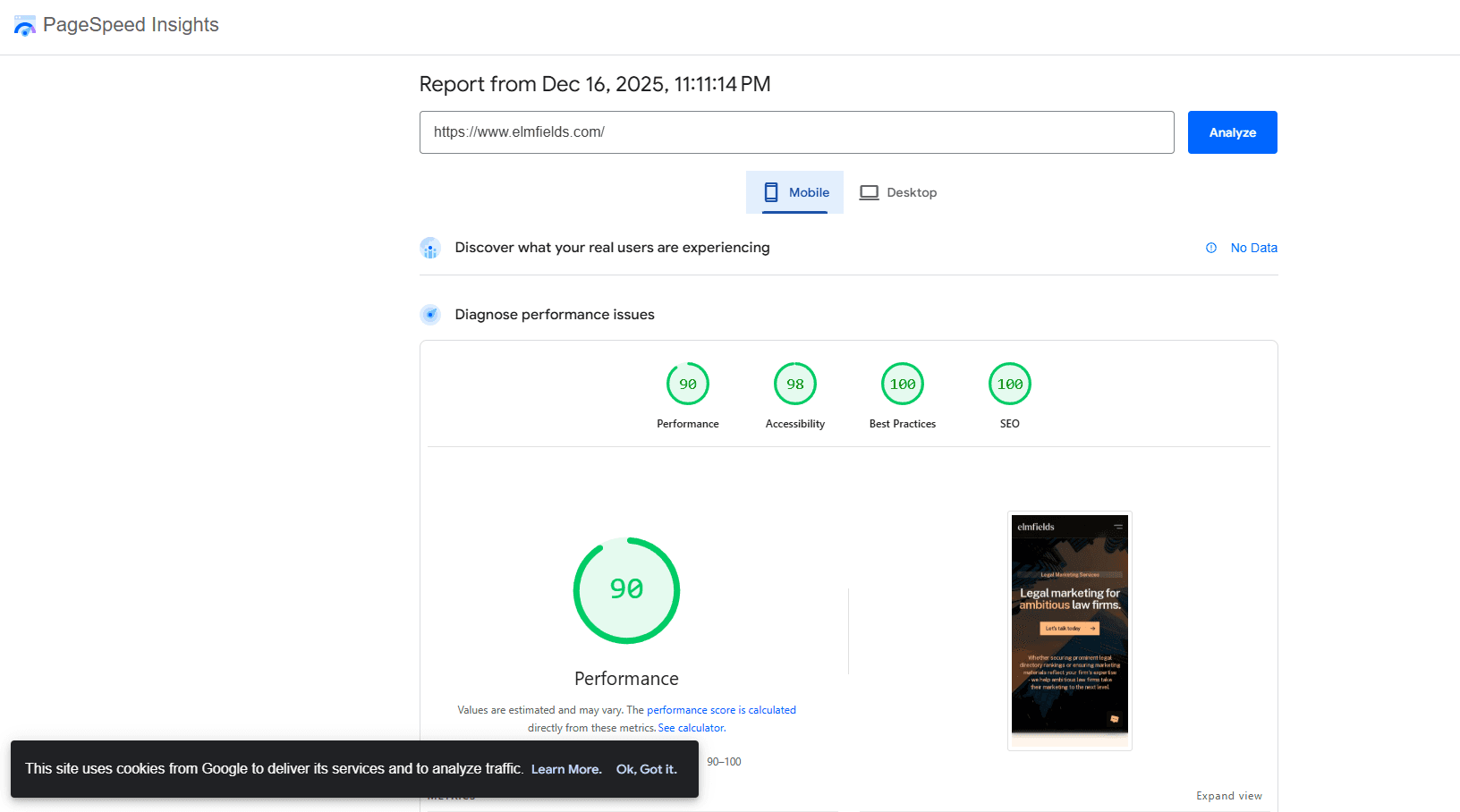
Rebuilt the site on a lightweight, secure content management system (CMS) optimised for speed. We recommend using Google's PageSpeed Insights to test how quick a website is. While this isn't a ranking factor, it does boost overall user experience (UX) by having faster loading times which decrease bounce rates (i.e. how quickly a user leaves your website after clicking). We are strong advocates for walking the walk when it comes to client work - see the Elmfields website score below:
2: SEO Strategy
When we began, the client was effectively invisible in search results for the keywords that drive enquiries to their business. Their generalist competitors were capturing the majority of organic traffic, leaving the client’s highly specialised offering buried beyond page three.
The site also lacked location-based pages and a Google Business Profile, meaning Google had no clear relevance signals for specific regions - a critical oversight given how many criminal cases are handled through local chambers and courts.
Read our article on how you can create location-specific Google Business Profiles to increase your service area visibility.
What we did
Created a comprehensive SEO roadmap based on short, medium and long-term ranking opportunities and focused on transactional and geographic intent. We use market-leading tools like Ahrefs and SEMrush as well as Google Keyword Planner, and the foolproof method of manually analysing the Search Engine Results Pages (SERPs) for the highest priority terms to match the intent on those SERPs.
Developed a new network of location pages to capture geographically qualified searches and establish local trust signals. While much of the content was the same, each page was carefully written to reflect the client’s experience with regional courts, legal aid familiarity, and specific case types handled in those areas.
Created content hubs around major practice areas (e.g., Forensic Psychology, Digital Forensics, Ballistics) with internal linking to the relevant location pages.
3: Building Authority
Despite strong technical foundations and better keyword targeting, the client’s site still lagged behind competitors with years of accumulated domain authority via backlinks.
In our experience, backlinks are a highly important ranking factor for search engines. We focused on earning high-quality, relevant backlinks from credible legal and forensic sources.
This was further complicated by the fact that the previous marketing agency the client had worked with provided them with backlinks that were definitely not suitable to their business - aimed at artificially boosting their 'Domain Authority'.
We needed to disavow these links first as in our experience, these do far more harm than good in terms of having a natural, contextually relevant backlink profile and can actually end up in your website being penalised as spam by the search engines.
What we did
Guest Posting: We identified and pitched to niche legal, forensic, and criminal justice blogs, contributing educational articles.
Niche Edits: We secured editorial link placements within existing, high-performing content on relevant domains - particularly on legal education portals and forensic industry sites. This helped transfer topical authority directly to key service pages.
4: Elevating Thought Leadership and Content Quality
The client’s existing content was technically informative but inconsistent in tone and presentation. Service pages lacked depth, blog posts were sporadic, and there was no cohesive structure to position the firm as a recognised authority in criminal expert witness work.
This limited both credibility with solicitors and visibility in search results, especially against well-established competitors producing regular legal content.
What we did
We developed a content and thought leadership plan designed to showcase expertise, improve user experience, and support SEO growth. The goal wasn’t just to publish more content - it was to create a library of professional materials that reflected the firm’s authority in the criminal law sector.
In our experience, good legal content marketing is about turning real conversations that people are having with your firm - and generally in the sector - into high-quality content that showcases your firm's authority.
We designed reusable, high-level templates for expert CVs, case summaries, and presentation decks. We also produced both short form topical blogs and in-depth pieces addressing evergreen questions from solicitors, which were all internally linked on the clients website to help with the overall SEO strategy.
5: Email Marketing and Lead Nurture
The client had accumulated a sizeable list of past and potential contacts - mainly solicitors, chambers, and legal aid organisations - but had never used it effectively.
Emails were infrequent, informal, and sent without segmentation or tracking, which meant no clear nurture process and little visibility into engagement.
We implemented a structured email marketing and lead nurture system to improve retention, build relationships, and convert more existing contacts into active clients.
What we did
List segmentation: Cleaned and categorised the database by region, service type, and engagement level (e.g. active solicitor, lapsed contact, or new lead).
Automated nurture sequences: Built short, educational drip campaigns that introduced the firm’s experts, outlined service areas, and shared insights (that we were publishing anyway as part of our content marketing strategy).
A/B testing: Constantly tested variations in subject lines, send times, and content formats to identify what resonated most with their audiences.
Performance tracking: Integrated open and click-through tracking with the client’s CRM to identify high-intent contacts for direct follow-up.
The challenges
Our client is a specialist expert witness provider serving the criminal law sector, supports solicitors, barristers, and legal aid organisations with expert testimony across forensic science, digital evidence, and psychological evaluation.
The client was struggling with:
A broken website infrastructure that limited search visibility.
Declining keyword rankings for competitive “expert witness” terms.
Fragmented organic marketing activity with no unified strategy.
The firm relied on word-of-mouth referrals but recognised the need to build a sustainable inbound lead engine.
Our organic marketing strategy
We created a unified organic marketing strategy split into 5 key steps:
Rebuilding the website for technical performance and scalability.
Improving visibility for high-intent keywords that drive enquiries.
Building authoritative backlinks to strengthen domain authority.
Developing high-level thought leadership content with consistent brand tone.
Implementing email marketing to nurture leads and past clients.
1: Deep Technical Website Rebuild
The client’s site had broken URLs, duplicate pages, and outdated architecture. Many important service pages were buried or inaccessible to crawlers.
This is a big problem - good overall website architecture is a key ranking signal for search engines, and doing these fixes safely by a web design & SEO professional is critical to improving organic online growth.
What we did
Full technical SEO audit and redirect mapping of old URLs.
Implemented structured data across the website to improve its search engine crawlability.
Optimised hosting and caching layers for sub-1.5-second load times.
Created a logical site architecture with clear topical clusters and internal linking.
Rebuilt the site on a lightweight, secure content management system (CMS) optimised for speed. We recommend using Google's PageSpeed Insights to test how quick a website is. While this isn't a ranking factor, it does boost overall user experience (UX) by having faster loading times which decrease bounce rates (i.e. how quickly a user leaves your website after clicking). We are strong advocates for walking the walk when it comes to client work - see the Elmfields website score below:
2: SEO Strategy
When we began, the client was effectively invisible in search results for the keywords that drive enquiries to their business. Their generalist competitors were capturing the majority of organic traffic, leaving the client’s highly specialised offering buried beyond page three.
The site also lacked location-based pages and a Google Business Profile, meaning Google had no clear relevance signals for specific regions - a critical oversight given how many criminal cases are handled through local chambers and courts.
Read our article on how you can create location-specific Google Business Profiles to increase your service area visibility.
What we did
Created a comprehensive SEO roadmap based on short, medium and long-term ranking opportunities and focused on transactional and geographic intent. We use market-leading tools like Ahrefs and SEMrush as well as Google Keyword Planner, and the foolproof method of manually analysing the Search Engine Results Pages (SERPs) for the highest priority terms to match the intent on those SERPs.
Developed a new network of location pages to capture geographically qualified searches and establish local trust signals. While much of the content was the same, each page was carefully written to reflect the client’s experience with regional courts, legal aid familiarity, and specific case types handled in those areas.
Created content hubs around major practice areas (e.g., Forensic Psychology, Digital Forensics, Ballistics) with internal linking to the relevant location pages.
3: Building Authority
Despite strong technical foundations and better keyword targeting, the client’s site still lagged behind competitors with years of accumulated domain authority via backlinks.
In our experience, backlinks are a highly important ranking factor for search engines. We focused on earning high-quality, relevant backlinks from credible legal and forensic sources.
This was further complicated by the fact that the previous marketing agency the client had worked with provided them with backlinks that were definitely not suitable to their business - aimed at artificially boosting their 'Domain Authority'.
We needed to disavow these links first as in our experience, these do far more harm than good in terms of having a natural, contextually relevant backlink profile and can actually end up in your website being penalised as spam by the search engines.
What we did
Guest Posting: We identified and pitched to niche legal, forensic, and criminal justice blogs, contributing educational articles.
Niche Edits: We secured editorial link placements within existing, high-performing content on relevant domains - particularly on legal education portals and forensic industry sites. This helped transfer topical authority directly to key service pages.
4: Elevating Thought Leadership and Content Quality
The client’s existing content was technically informative but inconsistent in tone and presentation. Service pages lacked depth, blog posts were sporadic, and there was no cohesive structure to position the firm as a recognised authority in criminal expert witness work.
This limited both credibility with solicitors and visibility in search results, especially against well-established competitors producing regular legal content.
What we did
We developed a content and thought leadership plan designed to showcase expertise, improve user experience, and support SEO growth. The goal wasn’t just to publish more content - it was to create a library of professional materials that reflected the firm’s authority in the criminal law sector.
In our experience, good legal content marketing is about turning real conversations that people are having with your firm - and generally in the sector - into high-quality content that showcases your firm's authority.
We designed reusable, high-level templates for expert CVs, case summaries, and presentation decks. We also produced both short form topical blogs and in-depth pieces addressing evergreen questions from solicitors, which were all internally linked on the clients website to help with the overall SEO strategy.
5: Email Marketing and Lead Nurture
The client had accumulated a sizeable list of past and potential contacts - mainly solicitors, chambers, and legal aid organisations - but had never used it effectively.
Emails were infrequent, informal, and sent without segmentation or tracking, which meant no clear nurture process and little visibility into engagement.
We implemented a structured email marketing and lead nurture system to improve retention, build relationships, and convert more existing contacts into active clients.
What we did
List segmentation: Cleaned and categorised the database by region, service type, and engagement level (e.g. active solicitor, lapsed contact, or new lead).
Automated nurture sequences: Built short, educational drip campaigns that introduced the firm’s experts, outlined service areas, and shared insights (that we were publishing anyway as part of our content marketing strategy).
A/B testing: Constantly tested variations in subject lines, send times, and content formats to identify what resonated most with their audiences.
Performance tracking: Integrated open and click-through tracking with the client’s CRM to identify high-intent contacts for direct follow-up.
The results
Over 18 months, our strategy transformed the client’s organic performance and lead generation capacity:
+300% increase in average monthly organic leads, driven by improved organic visibility, content quality, and email nurturing.
Key takeaways
Legal sector expertise matters: Non-legal marketing agencies often struggle in the legal sector because success depends on many nuances unique to this industry.
Strong technical foundations underpin everything: Without a clean site structure, crawlable pages, and fast load times, every other activity - from link building to SEO to content - would have underperformed. Technical SEO remains one of the most underlooked investments for legal service providers with older websites.
An integrated strategy drives organic growth: No single tactic delivered 300% lead growth in isolation. The results came from consistent execution across all channels: technical SEO, authority building, thought leadership, and nurturing.
Legal marketing support
If you're a legal services provider, and are looking to grow your organic leads, then get in contact with our team for a free consultation. We provide expert witness marketing services, as well as digital marketing for specialist legal support businesses.
More Case Studies
Read more on how we helped other legal sector clients achieve their marketing goals



© 2026 B2Bd Services Limited
Registered in England & Wales. Company No. 11833202
VAT no. GB457066673
© 2026 B2Bd Services Limited
Registered in England & Wales. Company No. 11833202
VAT no. GB457066673
© 2026 B2Bd Services Limited
Registered in England & Wales. Company No. 11833202
VAT no. GB457066673